Revisting Alzheimer’s and Dating

NL APRIL 24, 2026

On Life and Life After 50 eNewsletter

Columnist Tom Blake

RESPONSES TO HOPE LIVES ON

Last week, I wrote about Ann and Ben again. They represent a difficult, heart-wrenching issue seniors sometimes face: Dating when one of the couple’s spouses has severe dementia or Alzheimer’s Disease.

Previously, when we wrote about Ann and Ben’s first meeting a couple of years ago, most people disapproved of their relationship. But last week, Ann updated the situation and the responses were much more sympathetic to the couple continuing to see each other once per week or so.

Here are 12 responses (11 from women; one from a man):

Wayne shared, “Ann might want to ask Ben what his intentions are once his wife passes. Some need a mourning period after a loved one passes while others are ready to resume dating right away. I think she deserves an answer so she can prepare herself; it will also flush out how strong his feelings are towards Ann.

Francine said, “I’d like to put in my two cents. Ben is in a very stressful situation with his wife still living in the same home and ill with dementia. Of course, his first thought should be her.

“Having broken a date with Ann and then waiting for a few months to get back in touch with her, I would not trust him. I think he just needs someone to help fill the void in his life.

“I’ve had three men break off during the initial dating…married 2 and it ended in divorce. Now…my experience is not hers. Being teenagers and holding hands? Meeting once a week? You can’t build a relationship on that…there needs to be more intimacy.

“I’d suggest that Ann ask Ben that when his wife passes away, what are his plans for him and Ann? I’d be outspoken and direct. Unfortunately, both men and women can string you along, and have no problem walking away as you are simply the ‘interim’ person.

“I’m never a doom and gloom person but I’ve met way too many men. Plus, Ben’s wife might live for a long time. What would be Ben’s plans to advance his and Ann’s relationship further should that happen.

“We are not teenagers and our time on earth is limited as well. If Ann stays with Ben along this same road, I’d suggest she also date other men.”

Pat added, “Love is hard to find in any form. Ann and Ben seemed to have found a way to care for and love each other.  It is not our place to judge. I wish them well and that someday they can truly spend quality time together! 

“I believe in this “Love everyone…I will sort them out later. God”

Belinda, emailed, “Thanks for sharing Ann and Ben’s story. 

“I know there will be many Champs who disagree with me, but I think Ann and Ben have EVERY RIGHT to find their happiness where they can at this late stage of life — assuming that Ben’s wife is provided for, whether that be by him, or in a quality care facility.  HE IS STILL ALIVE, HIS LIFE GOES ON.

“When a loved one is incapacitated to the point where they are not going to get well and come back to normal brain functioning, that door is closed for their spouse or partner. Regardless of Ben providing great care for his wife, she is NOT going to get better over time.

“Why should the competent and still-able partner suffer along with them, giving up many years, even decades of what could’ve been the best time of their life?

“I think Ann and Ben are lucky to have found one another, and they obviously have a loving bond.

“Think about this, too: the bond Ben has with Ann is probably one of the major things in his life that pulls him through this time emotionally and mentally, giving him something to look forward to and YES, a reason for living, staying healthy, and being better able to manage his complicated situation.

“As Seniors, this is our time in life, the one we worked for so very hard over many years. Everyone deserves to be as happy as their situation allows. Ben is responsible and respectful when he’s with his wife and he provides her with loving care, as I’m sure he will continue to do for the remainder of her life. 

“He’s also deserving of his own happiness and his own future. 

I think Ann and Ben are doing JUST FINE. 

Thyrza, “My heart goes out for both of them. I believe Ann can have a platonic but loving relationship with Ben. If I were in her shoes, I wouldn’t feel bad nurturing such a relationship.”

Jan added, “Ann, take all you can get. Life’s too short to be alone. I have friends with Alzheimer’s and most of the time they’re not here anymore. Why should the husband be miserable? Enjoy every precious moment together.”

Kaitte, “I’ve worked with Alzheimer clients. It’s hard, a no joke situation. Having an outside relationship is healthier for the one left behind. Isolation and loneliness are not mentally or physically healthy. Ben does the best he can by lovingly caring for his wife. This situation gives him the support and love to be able to cope with it. And, it keeps him sane. 

Carolyn, “Oh My! I absolutely appreciate this most looked forward to eNewsletter from you Tom. What a quandary Ann is in right now!  It is heartwarming and heartbreaking at the same time. If Ben’s wife was not living in the same home where he lives, it would be a much better outcome for both Ann and Ben.

“Ben is ridden by guilt because after his lovely day with Ann, he has to go back home and see his still living but Alzheimer’s ridden wife. This situation is not a healthy one for sure. Ann is somewhat in a holding pattern waiting for the demise of Ben’s wife. This is not healthy for either of these lovely people. They are both caught between a rock and a hard place.

“Tom, what are your thoughts on this situation? Ann has so much more life to live with someone who would be present for her all the time.  There are no guarantees in life, however, we can control the situations that we become involved in. Ann has become Ben’s therapist and sidepiece! It’s definitely not good for Ann!

“Thank you for always keeping the Champs up to date on these most thought-provoking issues!  Whew!  This is certainly a tough one indeed!” 

S (a woman Champ), stated, “Has Anne verified that the wife indeed has Alzheimer’s? If true and advanced, I see nothing wrong with the relationship.”

Lynn, “What happened to ‘in sickness and in health, until death do us part?”

“I wonder how Ann or Ben would feel if they were the spouse in the care center?

“I’m confused, is this an on-line dating story? It seems to me that Ben likely misrepresented himself and Ann let herself be swept in?

Tom’s comment. Lynn, that isn’t what happened. Ben didn’t know Ann. He told a neighbor he was lonely. He did not misrepresent himself. He told Ann about his situation. Ann was lonely and yes allowed herself to fall in love, as so many of us have ‘allowed ourselves’ to do in our lives, when we’ve met someone, we were attracted to.

To comment on Lynn’s statement below, Ben treats his wife amazingly well dealing with her 10 years of dementia, with 24/7 caregivers.

Lynn continued, “Ann refers to Ben asking to end the relationship as a ‘one-day setback’, like he missed taking the trash out once. He clearly asked for an end to the relationship!

“I’m sure Ann can and will do what she wants to do, but this Tom catting (no pun intended) around is ridiculous. I for one am NOT buying what Ben is selling! In the event these two continue to carry on this relationship, does Ann think Ben will not treat her the way he is treating his current wife?

“WOW…that was a jaw dropper!”

New. “I don’t see anything wrong with Ann deciding to be with this man knowing all his story; he sounds like a real good man and taking care of his wife through all her bad health is commended.

 Virgina shared: Today people live longer. The marriage vow, “till death do us part” can be a cruel punishment. If one mate no longer has mental capacities to recognize and interact with a life mate, maybe we should take a good hard look at that vow, so it is adjusted to today’s longevity and health issues. Various religious beliefs and certain ancient rules and laws need to change with the times. 

Hope Lives On

On Love and Life After 50 eNewsletter

April 17, 2026

Columnist Tom Blake

On January 10, 2025, the eNewsletter was titled, “False Hope.” It was about a Champ named Ann, not her true name, who wrote that she had met a man named Ben (name changed also) whose wife had had Alzheimer’s Disease for 10 years.Ben’s wife still lived at home under his care. On Christmas Day, 2024, Ben contacted Ann and they met for a glass of wine that day and found they were attracted to each other, especially Ann attracted to Ben.

Ann emailed me often in early 2025 about her encounters with Ben. On May 26, 2025, Ann emailed me, “I heard from Ben on Mother’s Day, remember him with the Alzheimer wife? He lovingly wished me happy Mother’s Day and, of course, I was over the moon.

The next eNewsletter, January 17, 2025 (Both eNewsletters can be read on my FindingLoveAfter50.com website, featured 22 responses from Champs about the brief encounter Ann had with Ben. Almost all responses felt Ben was cheating on his wife and Ann was totally out of line.

“I thanked him and said I thought of him and hoped he was well. He also texted me on Easter, this coming from a man who wanted the door closed. I responded.

Last week, she emailed again.


“I have no idea how his wife is doing, apparently, she’s still here and things might be the same. I think you know how I feel about Ben; he is still the one for me.”

“Then, in the evening he responded to my text and said he also thought of me and here comes the next thing that sent me shivers, he said maybe someday we can go out for dinner.

Ann emailed me several times in 2025 and early 2026, always writing about Ben.

“I have been seeing Ben, I believe I wrote you after he bailed again but I did not follow up with what happened after. The next day, after the breakup, he texted me, it was heartbreaking to read how he poured out his heart.


“He said he didn’t know what had come over him, that life was so stressful with his wife still alive, but lovingly taken care every day and night.


“Ben said he had deep feelings for me and didn’t want to lose me, could I please forgive him and could we talk. We did and got some things straightened out; I felt more understanding as this continues to be a difficult situation for us both.


“Ben tries hard to include me in his life; he has a very busy business plus he visits his wife (living separately in their home) a couple of times a day.


“He obviously loves her and makes sure she has every comfort possible; I love that about him as well as other things. You know Tom, I have loved Ben for over a year, and I believe he had strong feelings about me and decided last Christmas to visit me again.

“Tom, there is never a guarantee in life, not for me, not for you or anyone for that matter.


“I believe I told you about our reunion, we just flew into each other’s arms after 10 months and almost cried with joy.
He had that little one-day setback but promised to never hurt me again.


“Ben has been loving and considerate since, we have gone out to dinner, to lunch and we see each other once a week, sometimes like this week, twice for lunch.


“We visit each other’s homes, and I feel comfortable in his house.
He holds my hand during lunch, kisses me frequently and thinks I am eye candy, a cute expression he uses.


“As I mentioned, it’s not ideal, I want to see more of him but know the limits, don’t want to push it and let him talk about his pain, (his wife and both daughters he lost a few years ago).


“It now has been almost three months of being together, I know he loves me and I am loving him.


“I am older now, it feels right to be with Ben and one day, we can spend more time together once his wife is no longer with us.
I am grateful for this love.”

Dating When A Spouse Has Advanced Alzheimer’s Disease

On Life and Love after 50 eNewsletterNovember 17, 2023
Part one – Dating When a Spouse Has Advanced Alzheimer’s
Part two – The New York Times mention
By Columnist Tom Blake 
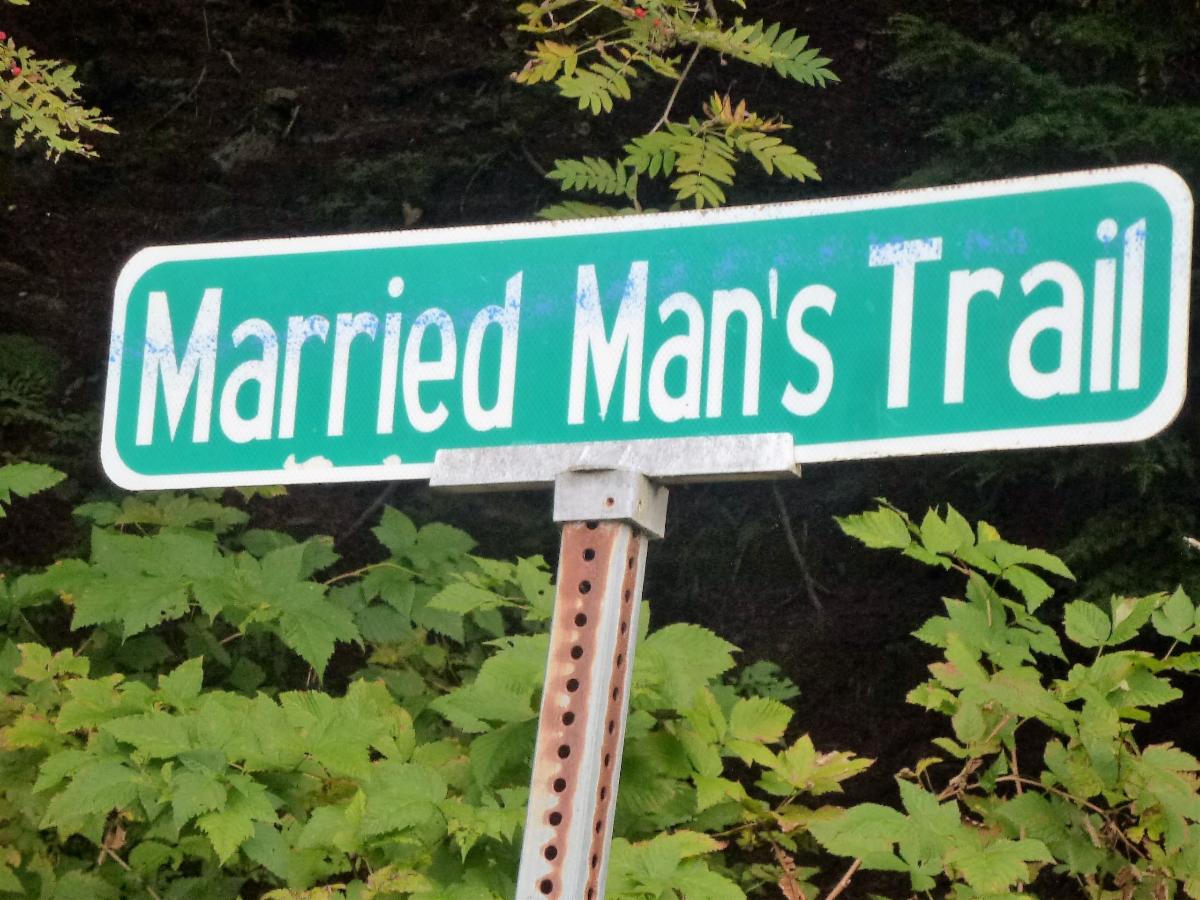
Photo by Tom Blake. Walking trail sign in Alaska Appropriate for Champ Bob’s Question
Part One – Dating When A Spouse Has Advanced Alzheimer’s

Champ Bob emailed me this week (week of November 13 2023) with a question. He wrote, “My wife, presently in ‘Memory Care,’ has been my friend and life partner for 53 years.

“I cared for my wife at home, as well as I could, during her early-onset Alzheimer’s Disease, which began five years ago. Now, she is almost non-verbal, and on medication, though lovely to see.

“Would a ‘friend’ relationship, open and honest, with guidelines be viable given my circumstances? I am 87, healthy with no limitations. My favorites: Travel, live theatre, dinner perhaps twice a week, walking and caring for my lovely home, music, and dancing.

“I am financially independent and believe I am open and honest with a good sense of humor. What do you think?”

Bob’s situation rang a bell. I wrote about this topic in May 2011. The title, “Dating When a Spouse is Institutionalized with Alzheimer’s.” I accessed that column from the archives. Not much has changed on this topic since then so I am quoting from it.

Words and quotes from the 2011 article

“When a spouse has Alzheimer’s disease, is committed to an institution, no longer recognizes her or his spouse, and it’s been going on for years, is it OK for that person’s spouse to seek comfort in a relationship?”

Ed said, My wife has early onset Alzheimer’s disease, a beautiful woman, age 59, whom I love very much. She is mentally gone now, doesn’t know me or anyone else, and sleeps much of the day. The rapid onset has been very discouraging; she has been in assisted living for two years.

“My family and friends are OK with my ‘moving on,’ as long as my wife receives the care she has now. I have no problem with that; I see her three to four times a week, but I cannot bring her home anymore.

“I met a widow two months ago. We see each other several times a week. We have tentative plans to do some traveling. Our relationship is platonic. She is very traditional. She says, ‘Who gives me a pass (the right) to date a married man?’

“Society, her friends, and the church we attend have sanctions, which she is concerned about. I don’t know how to answer her. What should I say?”
I asked Champs for their opinions (Remember, this is almost 14 years ago.)

What Champs said in 2011

Diane, who was in a similar situation, but with the roles reversed, said, “It’s a long and dark tunnel when going through Alzheimer’s with a loved one, but it helps to have a light at the end of that tunnel and someone waiting there for you who loves you.”

Gregory said, “Supreme Court Associate Justice Sandra Day O’Connor (the first woman to serve on the United States Supreme Court) dealt with the reverse situation. Her husband found a ‘friend’ while at the nursing home. Justice O’Connor was delighted he had someone to be with.”

Jon wrote, “Considering that there really is no marriage anymore, and his spouse is apparently unable to comprehend what is going on, a relationship is within reason.”

Cydne emailed, “If Ed’s friend is concerned about what other people think, her answer is no. I don’t worry about what society or others think about my life decisions. That’s why I’m so happy.”

Mary said, “There will always be some holier than thou, a judgmental busybody who will make her life miserable with criticism and condemnation. So what, go for it!”

George stated, “Alzheimer’s is a vicious disease. The dementia associated with it is irreversible. A victim can linger for years. Spouses are as ‘imprisoned’ as patients. If there is another person to whom a spouse can reach out, it’s not cheating or being unfaithful.”

I answered Ed, “You and your friend sound well matched. I feel you should cherish each other. You have a right to be happy as you have been loyal and wonderful and will continue to ensure your wife is well taken care of. And your friend has the right to be happy as well, as she learned from being a widow.

“As far as the ‘sanctions’ you mentioned, only your new friend can decide whether the sanctions are more important than happiness with you. Doesn’t God want us all to be happy? If the sanction sources are too judgmental, perhaps she should find more enlightened sources that are more accepting.”

My comments to Ed were blunt back in 2011. My feelings are the same now, with one added comment. Finding a new friend is okay, as long as the incapacitated person is unable to comprehend or understand. If they still have their mental facilities and are aware of what is going on, then no, it’s not acceptable at that time.

And those are the words I say to Bob.

By the way, after the article appeared in my newspapers in 2011, a man sent comments to the Letters to the Editor section. He wrote, “Doesn’t anyone believe in ‘commitment’ anymore? Does the phrase ‘To death do us part’ mean anything to anybody?”

I quote what Elvis once said, “Don’t criticize what you don’t understand, son. You never walked in that man’s shoes.”

A psychotherapist shares her opinions

I asked Debbie Sirkin, a South Orange County, California, psychotherapist, for her opinion about Bob’s question. Debbie said, “Bob’s situation can be a moral, ethical, and religious dilemma, and it is not one size fits all.
 
“For better or worse, in sickness and in health” is not Biblical in nature, but rather from a pamphlet titled, The Book of Common Prayer, from 1569, written at a time when people’s life expectancy was maybe 30-35 years. Alzheimer’s has only been around a little over 100 years, so this is not something anyone has had to deal with until the last century.

“Similar to many things discussed in premarital therapy, Bob’s situation may be a new one I add to my list of questions to be discussed before having to deal with it. Given where we are today, with living longer, I think this is a question that can/should be asked early in a marriage (or in premarital therapy). Then, being faced with this dilemma, it is no longer a dilemma, as it has already been discussed before the anguish at a time when you need more support and less stress.”

So, there you are Bob, you received a “thumbs up” from almost everyone who commented, enjoy a friend, while you can. 

I look forward to our Champs’ responses.  
Part 2 – A mention in the New York Times

One of our Champs is Tammy LaGorce, a wedding columnist for The New York Times. Recently, Tammy asked me for a quote for an article she was working on. Tammy mentioned she was writing about animals and relationships. I wasn’t sure when the article would appear.

Tammy had read our eNewsletter a few weeks back about “Dogs and Dating.”
Yesterday afternoon, I received a text from Champ Dee, who had received a text from her daughter Megan-Marie, who lives in Massachusetts. Meggie sent her a link to Tammy’s article, “When Your Significant Other Has Four Legs and Fur.” The article appeared yesterday.

Tammy LaGorce quoted me in the end of her article:

“Tom Blake, a relationship advice columnist in Dana Point, Calif., said that ‘most of the people I know who are content with their pet companionships still secretly admit they’d like a human partner.’ He encourages people to indulge that secret wish: “Go out and meet people. Hug your pet when you come home.”

Dee said, “I was so happy to see your name at the end of it (the very end of the article).”

Can you imagine? A Champ’s daughter in Massachusetts noticed it and alerted her mom. Thank you, Dee (who used to live in Dana Point), and thank you, Tammy LaGorce, for writing it.

“When Your Significant Other Has Four Legs and Fur” by Tammy LaGorce

Dating when a spouse has advanced Alzheimer’s Disease

On Life and Love after 50 e-Newsletter – November 23, 2018

by Tom P Blake

Dating when a spouse has Alzheimer’s Disease

Larry, 76, Toronto, emailed, “Re last week’s eNewsletter about dating a deceased friend’s spouse, I’m in a similar  situation. My wife has advanced Alzheimer’s disease, and no longer knows me. She’s been in a nursing home the past few years, and so I’m living a single life.

I’ve reached a point, where I’m ready for a new relationship. I’m really missing female companionship, in all its forms, and need that to change. I’ve started reaching out (with the full blessings/support of family, friends, and professionals), and have dated several women, all of whom are aware of and ok with my situation.

By the same token, I’ve also been rejected by several other women who are uncomfortable with the situation. So, as the article concludes – there is no right or wrong answer. Each individual caregiver needs to do what feels right to him/her.

Tom’s response: On the Finding Love After 50 Website, there are three articles I previously published on this topic under the article categories. It’s the first category listed. Here is the link to those articles:

https://www.findingloveafter50.com/alzheimer-s-dating-when-a-spouse-is

Larry: “Great! I’m off to visit my wife in the nursing home, and will check the articles later this afternoon.”

And then later, Larry wrote: “I just finished reading the three articles, and what struck me immediately, is that I can relate to most of the content in all of them!

“To give you some context, my wife and I have been together for 29 years, and until she went into long term care more than two years ago, we had never spent one night apart. As a matter of fact, we were rarely apart at all, as we worked together. What was our work you might ask? We were relationship counselors, helping couples deal with relationship issues. So, believe me, I can fully understand the issues facing the people in these situations.

“The bottom line for me (and I know my wife would agree), is that one must be true to self, and do or not do what he/she believes to be right. Although input from friends, family, professionals, clergy, etc., may be welcomed, and of some use, ultimately, the decision rests with the individual(s)/couple.

“In my case, I do have the full support of family, friends, and professionals, to reach out/date/socialize, etc., and if I do find another ‘special one,’ then, a committed romantic relationship would be welcome. That new relationship would not preclude my love for my wife, nor impinge on my visiting her regularly.

“If Champs want to contact me, my email is anoldnorthender@gmail.com.”

Comments from Champs (readers) to this article on November 30, 2018

Last week’s topic, dating when a spouse has Alzheimer’s, was/is a controversial topic.

I am aware of that. A small number of Champs responded in horror that someone would venture out despite a spouse being in advanced stages of Alzheimer’s. They are sticking by their wedding vows forever. End of story. Regardless of what happens.

One person who feels that way was critical of others who feel differently.

Others, particularly, those who have experienced a similar situation, or are currently experiencing it now, take a much more understanding and empathetic point of view.

My thoughts: This is a topic that couples (not just married couples, but, any committed couple) might want to discuss “what if?” while they are both lucid, clear thinking, and far before the issue presents itself. What each couple decides is right for them is exactly that: right for them.